
King Cobra Builds a Nest to Protect Its Eggs
King cobra females build leafy nests for their eggs, guard them during incubation and leave before hatching, revealing a remarkable reproductive strategy among snakes in the wild and tropical forests.
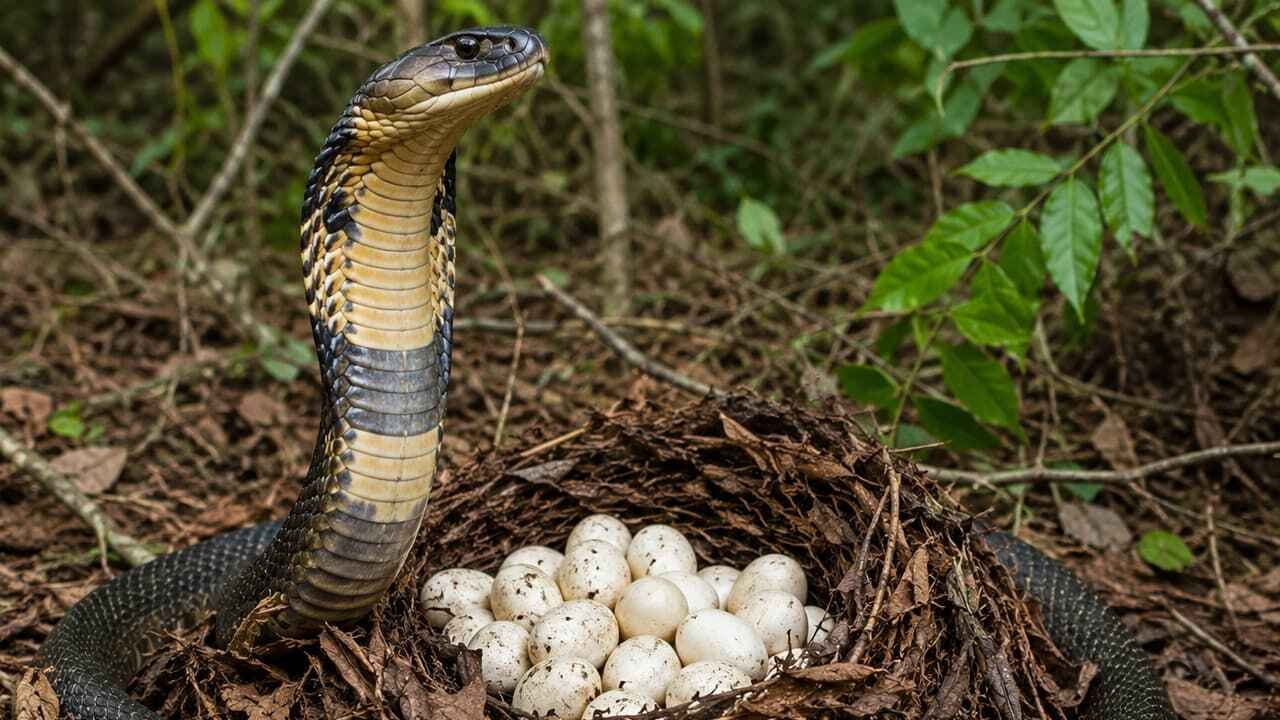
The king cobra is known for its size, venom and distinctive hood, but its breeding behaviour makes the species even more unusual. Unlike most snakes, the female king cobra builds a nest for its eggs and remains nearby to protect them during incubation.
King cobras are among the longest venomous snakes in the world. They are found across parts of South and Southeast Asia and generally live in forested habitats where they can find suitable prey and shelter.
The nest building begins when the female gathers dry leaves, small branches and other plant material from the surrounding area. She uses her body to move the material into a pile and shapes it into a protected nest.
The nest is usually built in a location where the eggs can remain relatively sheltered from water and other environmental threats. Depending on conditions, the female may place a substantial layer of vegetation above the eggs after laying them.
A clutch can contain several dozen eggs. The exact number varies, but king cobra nests have been documented with roughly 20 to 40 eggs in some cases.
One of the most interesting aspects of the nest is that it can generate heat naturally. As the leaves and other vegetation begin to decompose, the biological process produces warmth inside the nest. This helps create a more suitable environment for developing eggs.
The female also remains close to the nest during much of the incubation period. This behaviour is unusual among snakes because many species leave after laying their eggs and do not provide prolonged protection.
During the nesting period, the female can become highly defensive. If a person or another animal approaches too closely, the snake may raise its body, spread its hood and produce a warning sound. Such behaviour is particularly important because eggs and nests can attract predators.
The incubation period can last several weeks and may extend for around two months depending on environmental conditions. Temperature, humidity and other factors can influence the development of the eggs.
Claims that the female survives for exactly 60 days without food or water should be treated cautiously. Nesting females can greatly reduce feeding while guarding eggs, but the duration and extent of fasting can vary with individual snakes and environmental conditions.
The most striking behaviour happens shortly before the young emerge. The female typically leaves the nest before hatching begins rather than remaining there until the hatchlings appear.
Researchers have suggested that leaving the nest may reduce the possibility of the hungry adult encountering and eating newly hatched young. King cobras are predators, and their diet normally includes other snakes and occasionally other vertebrates.
This behaviour gives the species an unusual combination of nest building and parental defence. The female invests considerable effort in preparing a protected environment and guarding the eggs, but eventually moves away before the young emerge.
The nest itself is an example of how animal behaviour can develop around local environmental conditions. Instead of simply depositing eggs in an existing shelter, the female creates a structure using materials available on the forest floor.
The location of the nest also matters. A suitable site needs to provide protection from excessive water while offering a stable environment for egg development. Vegetation surrounding the nest can provide additional cover from predators and weather.
King cobra reproduction therefore differs considerably from the behaviour commonly associated with snakes. The species does not simply lay eggs and immediately disappear. The female spends considerable time preparing the nest and defending it during incubation.
At the same time, the young are not raised by the mother after hatching. Once the eggs hatch, the young king cobras must survive independently and begin developing the hunting and defensive abilities needed in the wild.
The combination of nest construction, prolonged guarding and departure before hatching has made king cobra reproduction an important subject for wildlife researchers. It also shows how different reproductive strategies can develop among reptiles.
The king cobra’s nesting behaviour is a reminder that snakes are far more diverse in their behaviour than their reputation often suggests. While the species is capable of defending itself aggressively when threatened, its breeding cycle also involves a carefully organised process of nest construction and egg protection.
For wildlife observers, however, king cobra nests should never be approached or disturbed. The female may become defensive when she believes the eggs are under threat, making a safe distance essential.