Centre Proposes New Ration Distribution Rules With Per Person Grain Allocation
The proposed ration policy aims to distribute food grains based on family size while ensuring eligible beneficiaries continue receiving free rice and wheat under existing welfare schemes.
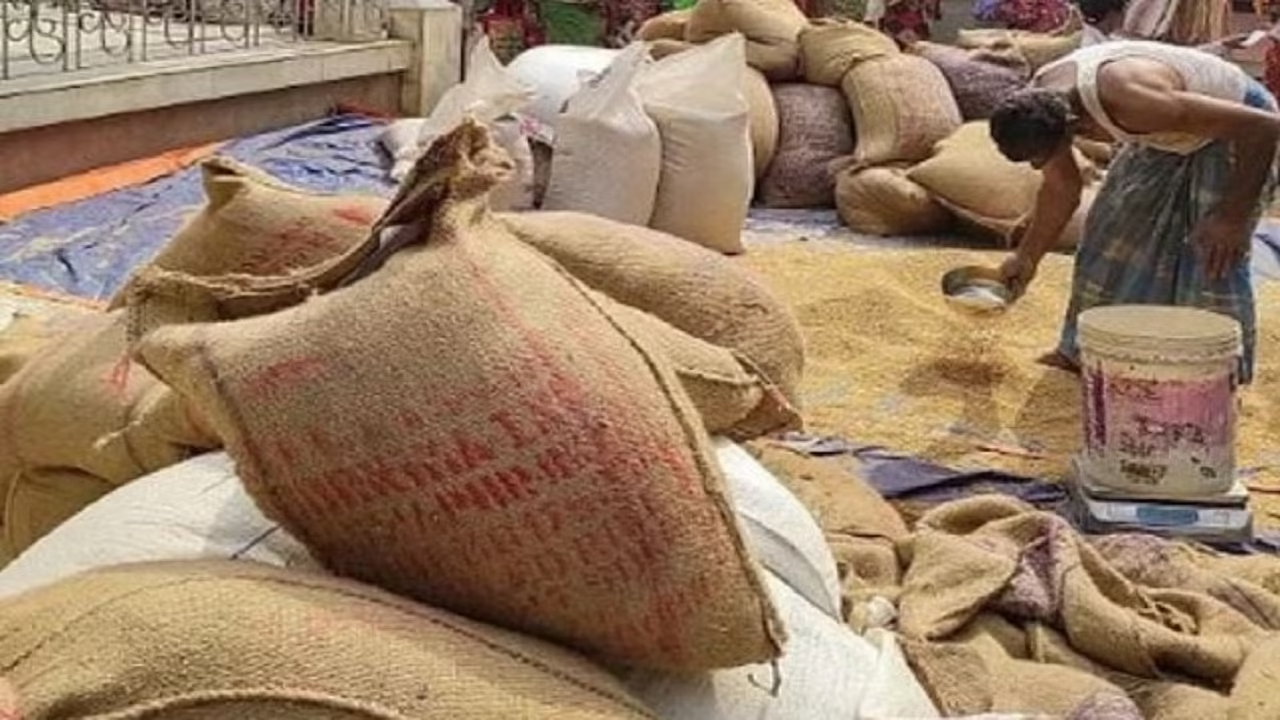
The Central Government has proposed significant changes to the country’s ration distribution system with the objective of making food grain allocation more equitable for economically weaker families. The proposed amendments focus on changing the way food grains are distributed under the Antyodaya Anna Yojana by shifting from a fixed family based quota to a per person allocation model.
At present, families covered under the Antyodaya Anna Yojana receive 35 kilograms of free food grains every month regardless of how many members are in the household. In contrast, beneficiaries under the Priority Household category of the National Food Security Act receive five kilograms of food grains per person every month. Officials believe this difference has created an imbalance, especially for larger families covered under the Antyodaya scheme.
To address this issue, the government has proposed amendments to the National Food Security Act 2013. Under the new proposal, eligible beneficiaries under the Antyodaya Anna Yojana would receive seven kilograms of food grains per person every month instead of the current fixed allocation per family. However, the total quantity for any single household would continue to be capped at 35 kilograms per month.
According to the proposal, a household with two eligible members would receive 14 kilograms of food grains every month. Families with five or more members would continue to receive the maximum allocation of 35 kilograms. The government says this approach is intended to improve fairness by linking distribution more closely to the number of beneficiaries in each family while maintaining an upper limit.
Officials have pointed out that under the existing system, large families often receive less food grain per individual because the monthly quota remains fixed at 35 kilograms irrespective of family size. The proposed changes are intended to reduce this disparity and provide a more balanced distribution for eligible households.
The Department of Food and Public Distribution has invited public feedback on the proposed National Food Security Amendment Bill 2026 before moving ahead with the legislative process. The consultation is aimed at gathering suggestions from citizens and stakeholders before the amendments are finalized.
The government has also clarified that the supply of free rice and wheat to eligible beneficiaries will continue under the existing welfare programme. The proposed changes relate only to the method of allocation and are intended to improve the effectiveness of food grain distribution rather than reduce the benefits available under the scheme.
If approved, the revised policy could reshape the way ration benefits are calculated for millions of eligible households across the country. The final implementation, however, will depend on the passage of the proposed amendments after the consultation process is completed.