Elon Musk’s Neuralink Begins Preparing for Vision Chip Trials That Could Change Sight Forever
Neuralink is developing the Blindsight brain implant to help blind people regain vision by sending visual signals directly to the brain through advanced computer technology.
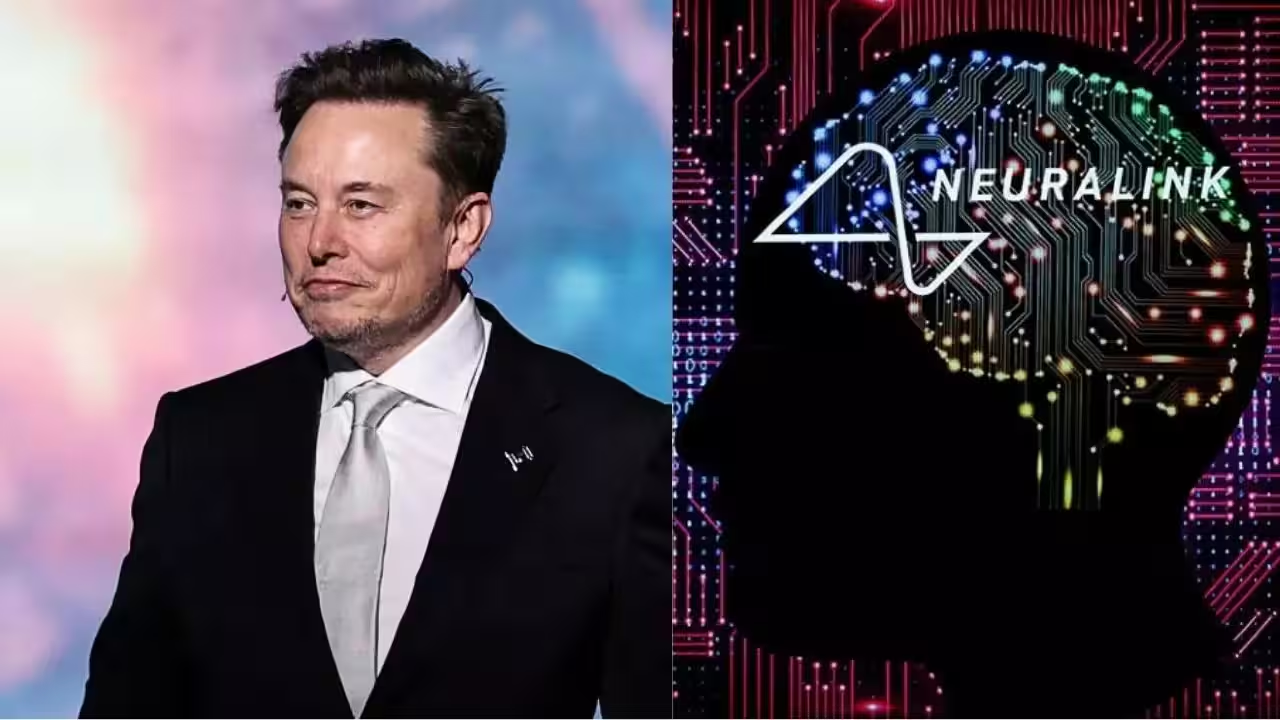
Elon Musk’s brain technology company Neuralink is moving closer to a major medical experiment that could change the future of vision restoration. The company is developing a new implant called Blindsight, which is designed to help people who have lost their eyesight by transmitting visual signals directly to the brain.
Neuralink is expected to begin the first human trials of the vision implant within the next six to twelve months. The announcement has attracted global attention as the technology could create new possibilities for people who are blind due to damaged eyes or optic nerves.
Unlike traditional vision correction methods that depend on functioning eyes, the Blindsight implant focuses on bypassing damaged parts of the visual system. The device aims to deliver information directly to the visual cortex, the area of the brain responsible for processing vision. Musk has suggested that the technology could potentially help even people who were born blind, although extensive testing will be required to confirm its effectiveness.
The system is expected to work with external hardware such as specialized glasses or a headset that captures images from the surrounding environment. These visual signals would then be converted into electronic information and transferred to the implanted chip, which would stimulate the brain’s visual cortex. This process could allow users to perceive images without relying on natural eyesight.
The technology has already received breakthrough device designation from the United States Food and Drug Administration, highlighting its potential importance in medical research. However, receiving this status does not guarantee success, as the implant must still pass multiple stages of safety and effectiveness testing before it can become widely available.
Musk has explained that the initial version of Blindsight may provide only basic visual information. Early users may experience low resolution images similar to old retro video game graphics, where recognizing shapes and patterns would be possible rather than seeing detailed natural vision. Over time, improvements in hardware and software could increase image quality, according to Musk.
The Tesla and SpaceX founder has also discussed the possibility of expanding human vision beyond normal limits through future versions of the technology. He has suggested that advanced versions of the implant could potentially allow humans to process wavelengths such as infrared or ultraviolet, which are normally invisible to the human eye. However, such possibilities remain theoretical and require significant scientific validation.
While the project has created excitement in the technology industry, medical experts are urging caution. Neuroscientists point out that directly interacting with the brain to create visual perception is an extremely complex challenge. Understanding how the brain interprets artificial signals and ensuring long term safety will require years of research.
Experts also note that creating enhanced human abilities beyond normal vision is still far from reality. Current research is mainly focused on restoring basic visual functions for people with severe vision loss rather than providing extraordinary abilities.
Despite the challenges, Neuralink’s Blindsight project represents an ambitious step in the field of brain computer interfaces. If successful, the technology could open a new chapter in medical science and offer hope to millions of people affected by blindness around the world.