
China Achieves Major Fusion Breakthrough With World’s Largest Superconducting Magnet
China has successfully built and tested the world's largest superconducting fusion magnet, marking a major milestone in clean energy research.
China has taken a major step toward its ambition of creating clean and nearly unlimited energy by successfully building and testing the world’s largest superconducting fusion magnet. The achievement strengthens the country’s long term plan to produce electricity using nuclear fusion by 2030 and has drawn global attention as nations race to develop carbon free energy technologies.
The newly completed magnet is one of the most critical components of a fusion reactor. Its primary role is to control extremely hot plasma that reaches temperatures above 100 million degrees Celsius. By generating a powerful magnetic field the system keeps the plasma suspended without allowing it to touch the reactor walls making the fusion process possible.
Developed by the Institute of Plasma Physics under the Chinese Academy of Sciences the toroidal field superconducting magnet measures 21 meters in length and 12 meters in width while weighing around 582 tons. Researchers say it is about 1.3 times larger than the magnets designed for the ITER international fusion project and is capable of storing nearly three times more magnetic energy.
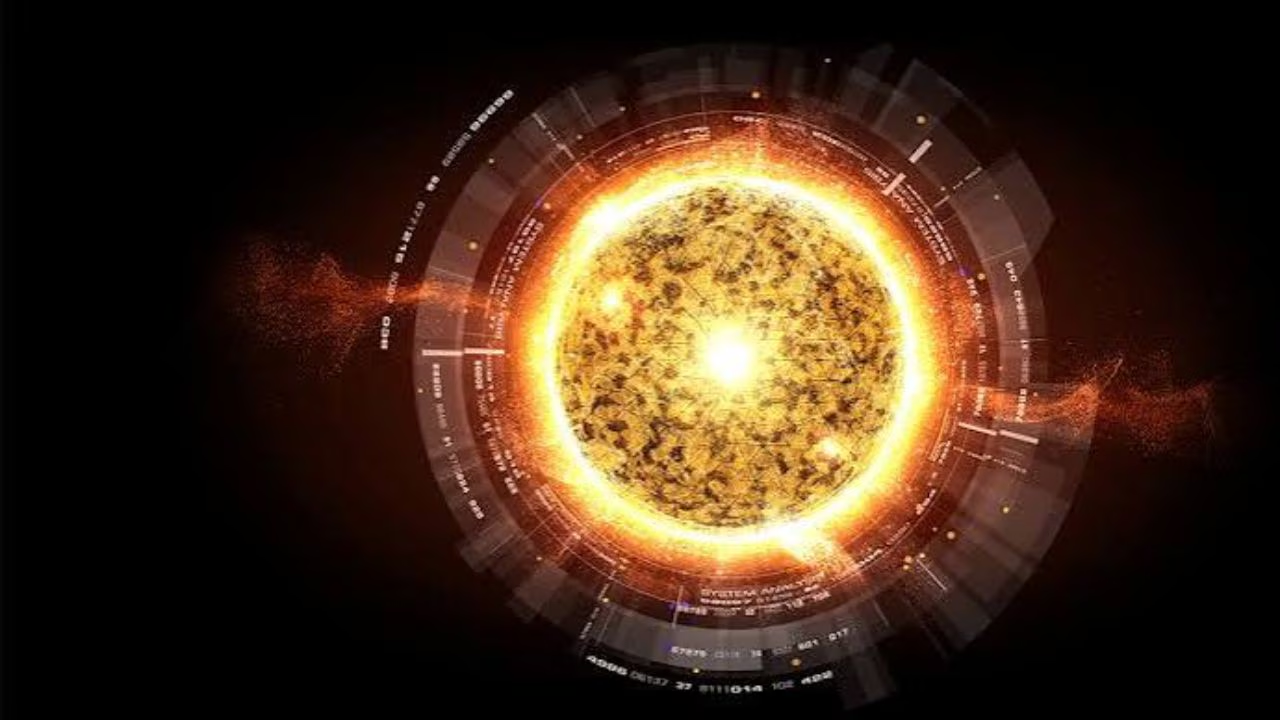
Fusion technology often referred to as the creation of an artificial sun aims to recreate on Earth the same nuclear fusion process that naturally powers the Sun. During this reaction hydrogen atoms combine under extremely high temperatures releasing vast amounts of energy. Unlike fossil fuels the process does not produce carbon dioxide emissions making it one of the most promising sources of clean electricity for the future.
China also confirmed the successful testing of its high temperature superconducting central solenoid coil another key component inside a fusion reactor. Scientists compare its function to a spark plug in a car engine because it helps initiate and sustain the plasma needed for continuous fusion reactions.
Engineers faced enormous technical challenges while developing the massive magnet. The system is designed to operate at temperatures as low as minus 269 degrees Celsius while carrying electrical currents exceeding 100000 amperes with almost no energy loss. It has also been engineered to withstand intense radiation and mechanical stress with an expected operational life of around 60 years.
Another notable aspect of the project is that all major components were developed using domestic materials and homegrown manufacturing technologies. Chinese researchers said this reduced dependence on foreign suppliers while helping advance the country’s own industrial capabilities. The six year research program also resulted in 47 patents and the creation of 25 industry standards.
Earlier this year China made headlines after its Experimental Advanced Superconducting Tokamak reactor maintained plasma at 100 million degrees Celsius for 1066 seconds setting a new world record. That achievement demonstrated the country’s growing expertise in fusion research and laid the foundation for the latest breakthrough.
China now plans to complete its next generation fusion reactor by 2027 before attempting to generate electricity through fusion by 2030. The country has also expressed its long term ambition of building the world’s first commercial fusion power plant. While scientists acknowledge that several technological hurdles still remain before fusion becomes commercially viable they describe the latest success as an important milestone that brings the world one step closer to a future powered by clean zero carbon energy.