
Rising Fear Over AI Jobs Sparks Global Debate as New Survey Reveals Deep Worker Anxiety
A fresh Reuters Ipsos survey shows growing public concern over artificial intelligence threatening jobs and income stability while experts, workers and policymakers debate the future of employment and economic security worldwide
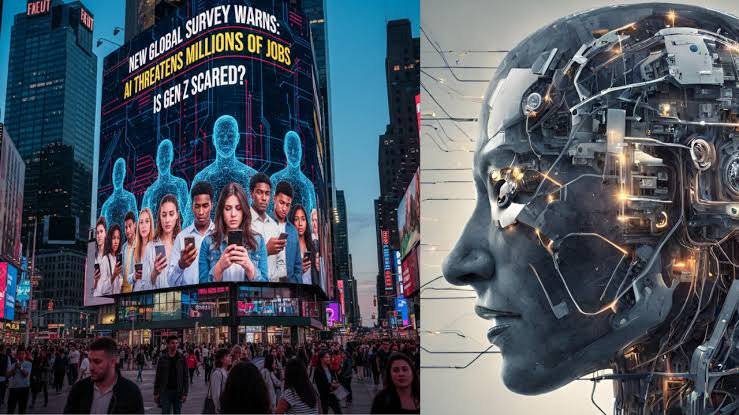
Artificial intelligence is expanding at a pace that is reshaping industries across the world, but along with this rapid growth comes a rising wave of concern among workers. A recent Reuters Ipsos survey highlights that more than half of Americans now believe AI could put their jobs at risk or impact the livelihood of their families. This anxiety is not limited to any one group and is visible across different age and education levels.
The fear is not coming out of nowhere. Major technology companies have already started restructuring their workforce to align with AI driven systems, leading to noticeable job reductions. Large firms such as Intuit have scaled down employee strength as automation becomes more deeply integrated into operations. Even former tech leaders like Eric Schmidt have publicly discussed how AI could reshape employment in ways that are still not fully understood, adding to public uncertainty.
At the same time, the conversation around AI has moved beyond boardrooms and into everyday life. Students have raised concerns about future job opportunities, while workers in creative fields report increasing pressure from automated tools. Freelance writer Jennifer Schallhouf has pointed out that companies are often prioritizing lower cost solutions over human quality work, reflecting a growing tension between efficiency and employment security.
Political opinions on AI’s impact also show a clear divide. According to the survey, around 61 percent of Democratic supporters feel AI could negatively affect household finances, while the number is lower at 47 percent among Republican respondents. These differences highlight how economic fears linked to technology are now becoming part of broader political discussions.
Since the arrival of tools like ChatGPT in 2022, AI has rapidly moved from experimental technology to everyday utility. It is now used in coding assistance, content creation, business planning and many other areas. However, usage remains uneven. College graduates are significantly more active users, with nearly half using AI regularly, while overall public usage remains lower at around 40 percent.
Despite its benefits in improving productivity and simplifying tasks, AI is still viewed by many workers as a potential threat rather than a support system. The concern is not just about losing jobs but about how quickly traditional roles are being redefined. Economists suggest that while technology will continue to create new opportunities, the transition period could be difficult for large sections of the workforce.
The central question now is not whether AI will continue to grow, but whether society can adapt fast enough to protect livelihoods and ensure fair opportunities. For millions of workers, the future feels uncertain, and how this balance between innovation and employment stability is managed will define the next phase of the global economy.