Apple and Google Raise Concerns Over India’s Satellite to Phone Internet Plans
India is moving toward direct satellite smartphone connectivity, but Apple and Google have warned about hardware challenges, battery issues and network complexities before large scale rollout becomes practical nationwide.
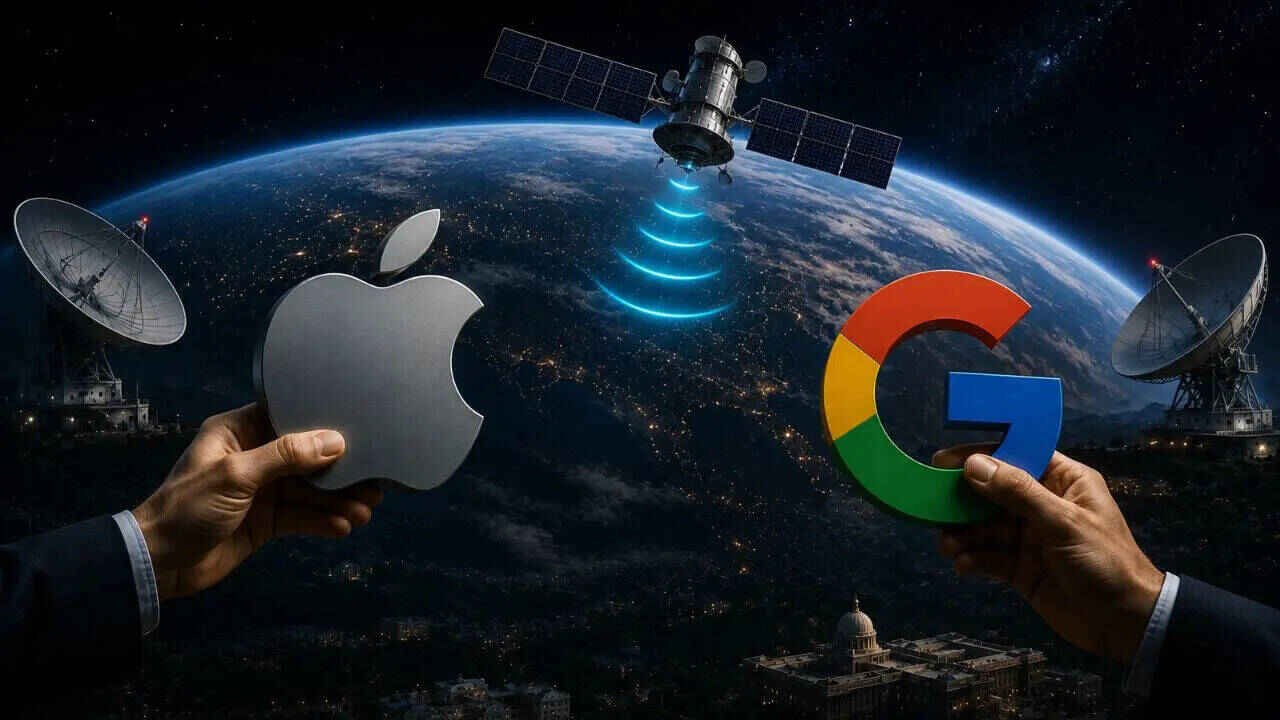
India’s plans to bring satellite powered internet directly to smartphones are gaining momentum, but the technology is also triggering caution among some of the world’s biggest tech companies. Apple and Google have reportedly shared several concerns with the Department of Telecommunications during recent discussions around direct to device satellite communication systems.
The proposed technology aims to allow ordinary smartphones to connect directly with satellites in areas where traditional mobile towers are unavailable or unreliable. Such services could become highly useful in remote villages, mountainous regions, forests and disaster affected locations where normal network coverage often fails.
However, according to reports, both Apple and Google believe the ecosystem still needs more refinement before mass adoption becomes practical. Their concerns reportedly focus on technical limitations, hardware requirements and the challenge of integrating satellite systems with existing 4G and 5G mobile infrastructure.
Apple is said to have emphasized that future satellite communication services should ideally work without forcing major hardware changes or additional certifications for smartphones. The company reportedly highlighted the importance of protecting the stability and security of existing mobile networks while the new ecosystem develops.
There are also concerns about international satellite coordination and regulatory approval in countries where satellite communication policies are still evolving. Since satellite signals cross borders, global coordination could become one of the biggest challenges for companies planning to offer such services worldwide.
Google reportedly shared similar views during the discussions. The company is believed to have pointed out several technical barriers that still affect direct satellite smartphone connectivity. These include faster battery drain, antenna limitations inside compact smartphones and concerns related to signal strength and stability.
Another challenge involves smoothly integrating satellite connectivity with existing mobile networks. Experts believe maintaining seamless switching between terrestrial towers and satellites may require deeper software and hardware level optimization in future smartphones.
India has not yet finalized a complete regulatory framework for direct to device satellite services. Current discussions are mainly focused on understanding the technology, identifying spectrum requirements and evaluating how such systems can coexist with existing telecom infrastructure. The Telecom Regulatory Authority of India is also studying possible operational models for future rollout.
Globally, satellite based smartphone connectivity is already attracting serious attention. Countries including the United States, Canada and Australia have begun testing similar services. In the US, SpaceX owned Starlink has partnered with T Mobile to test satellite to phone communication in areas with weak or no cellular coverage.
Despite growing interest worldwide, industry stakeholders believe the technology still requires several years of development before it becomes widely accessible for everyday smartphone users. Issues related to pricing, regulation, compatibility and network performance will play a major role in determining how quickly satellite internet services reach consumers.
For users, the biggest advantage of this technology could be uninterrupted communication in places where regular mobile signals disappear completely. Still, companies appear cautious about rushing deployment before the ecosystem becomes mature enough to deliver reliable and secure performance on a large scale.
As India continues exploring direct satellite smartphone connectivity, the coming years may shape an entirely new phase of mobile communication where phones remain connected even far beyond the reach of traditional towers.